Monday, May 14, 2012

Fuel arrives


 I just liked this photo.


 We heard the helicopter before we saw it. The village has been on a fuel ration for months. This load was the first of several that lasted a few hours. Of course it was the hit of the classes on that side of the building, so not much got done. Some classes went outside going as far as on the other side of the fuel tanks to watch the one tank be lowered and dropped off, and have the second hook up and leave.


Close up of the helicopter dipping on the backside of the tanks.


Men filling up local tank.


 Another load.


 $600 dollars an hour. Not sure what fuel will cost now.


     Not much getting done....

Wednesday, May 9, 2012

The days are longer....


 The days are getting to be almost 17 hours of daylight. The sunset is about 11:15 PM which makes it tough to go to bed on the early side. We all feel it. The students come in tired, or not at all.


With the longer days, the migratory birds find their way back to their nesting grounds. Ducks, geese, swans, cranes are off in the distance calling each other. Each time I've been out a flock of something goes overhead in V formation. But, I did see one lonely seagull finding its way upriver, maybe to the dump?


 Sad to see for many of us, the Tundra Swan is sought after as it feeds many. It is a beautiful animal. The Speckled Duck and Cackling Canada Goose were among the catch.


 I took the wings home to cut the feathers off to use for next year's Cultural Week. The men's dance fans use bird feather (swan or owl). I brought these incredible things into the bathtub and cut as many feathers off as I could. I also cut the down and tucked it away in a bag.

I was amazed at the variety of feathers, like any bird I'm sure, and kept exploring the layers upon layers on these wings.  My bathtub looked like someone had had a pillow fight in it!


 Not everyone plucks their birds. One method it to tear the skin to get at the breast meat.


 Sunrise is now happening about 6:15 AM. Getting out for walks at this time of day is a treat. The snow has an icy surface, so one doesn't break through so easily. And, again, the birds are on the move. I saw my first robin today.

  Spring brought the white spotted Northern Pike. Most people around here had to go to the mouth of the Johnson River to go ice fishing for them. They do come up to the local river, but now the ice is too unstable to go out on.


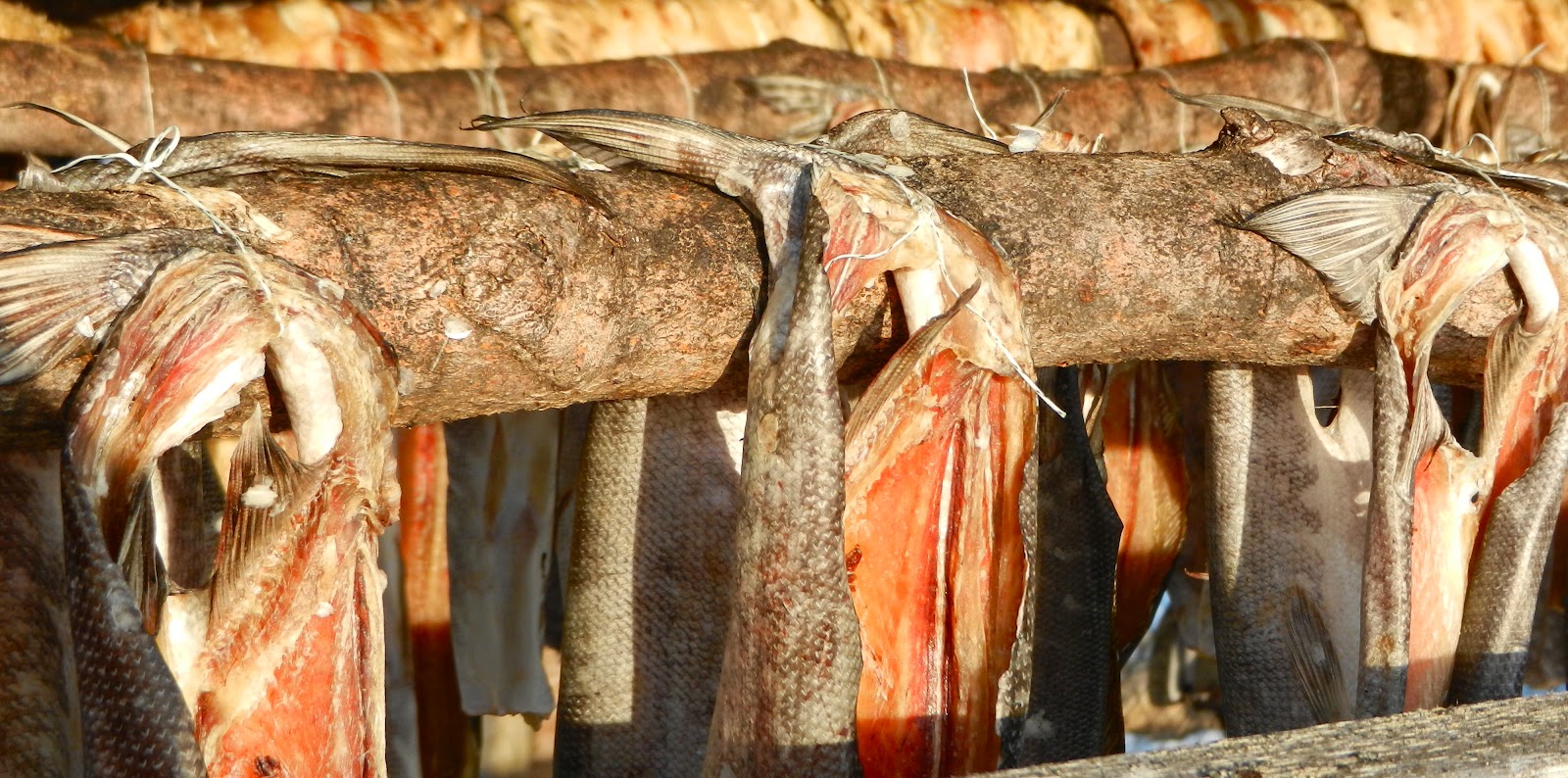
  This family has been hard at work putting up this fish. Cleaned, split and hung to dry they will be put away. Many families have extra freezers to store them.


 Alongside the fish, this family has stripped and split ptarmigan to dry.


This is another way to lay out fish. I'm not sure if these are still Pike or if they are the local Shefish.

Tuesday, May 8, 2012

Akula Kasigluk


It's definitely warming up! Took a ride over to Nunapitchuk (for the burger and fries) and headed over to Kasigluk to get some photos of their wind turbines.


 Tundra starting to peek out under snow cover.


 While off and exploring found this beaver lodge. There are fox tracks up and over the top.


 Akula is located on a small river that is a tributary of the Johnson River. It is the "newer" village of Kasigluk. It is also where I was first hired after student teaching in Newtok.

Akiuk is the older of the two parts of Kasigluk. It is upriver just a short ways.


 When crossing the river we came across this channel. It was actually an overflow that had used the plowed "road" on the river to fill in. It came as a surprise as we didn't see it until we were almost in it!


 Finally, some real live ptarmigan, whiter than snow! There were several flocks on the way back in the shrubs.


Monday, May 7, 2012

Love home visits!


Above, kids everywhere love to play in water!

With home visits you never know what you'll be walking into. Camera was being off in color (I must have messed with something...don't know what, yet) so black and white seemed the best. That also helps with the innards of a spotted seal. The husband had come home from Chevak with this food source.


 The fat will be sliced and put in jars to render down. Seal fat/oil is highly prized and has many uses.  Since so much fish is eaten out here, dried usually, it is dipped in this oil, a favorite among most around here.


 On the coast it is common to see seals being cut inside and outside homes. Not so here in tundra villages. The ulu (women's knife) is used to begin to divide the fat from the skin. The meat, liver and heart will be eaten. There has been some concern about the health of the animals as the seals off our coast have some disease where there are skin lesions and hair loss.


 Walking home, there are signs of spring. Bikes are emerging from the snow drifts.


Below, an old box spring. I loved the designs and shadows.


 Lazy days for dogs.


 A fortunate family set for next year's winter.


 Mud, definite sign of spring.


Below, more lazy dogs.


 This  is a great set of photos of some boys playing in the water with "boats" they made out of flattened cans with a piece of a 2x4 nailed on.

They would throw their boats across the water to see how far they would skim across the surface before sinking. Brrrr... cold hands.

The very last photo are some little girls playing chase.